HomeCorona UpdatesCoronavirus daily news updates, June 6: What to know today about COVID-19 in the Seattle area, Washington state and the world – The Seattle Times
Coronavirus daily news updates, June 6: What to know today about COVID-19 in the Seattle area, Washington state and the world – The Seattle Times
With vaccination rates in many parts of the U.S. and Europe increasing, more and more of life is re-opening, though the path taken on either side of the Atlantic differs markedly, with Europe and the U.K. taking a much more cautious tack.
Meanwhile, much of the rest of the world continues to struggle to obtain and administer vaccines.
We’re updating this page with the latest news about the COVID-19 pandemic and its effects on the Seattle area, the U.S. and the world.
Click here to see previous days’ live updates and all our other coronavirus coverage, and here to see how we track the daily spread across Washington and the world.
British Prime Minister Boris Johnson will use the Group of Seven wealthy democracies’ summit next week to urge world leaders to commit to vaccinating the global population by the end of 2022.
Johnson is expected to stress the importance of a global vaccination drive when he meets with fellow world leaders on Friday in Cornwall, on England’s southwestern coast, for the first face-to-face G-7 summit since the pandemic hit.
“The world is looking to us to rise to the greatest challenge of the postwar era: defeating COVID and leading a global recovery driven by our shared values,” he said in a statement Sunday. “Vaccinating the world by the end of next year would be the single greatest feat in medical history.”
U.S. President Joe Boden and the leaders of Canada, France, Italy and Japan will arrive in Cornwall from Friday for three days of talks focusing on the global recovery from the pandemic.
Read the whole story here from the Associated Press
Going back to church? A new question, as communities re-open
Monsignor Edward Filardi of St. Paul Catholic Church in Damascus, Md., greets his community after a Saturday service on June 5. He is holding the hand of Virginia Rhodes, an original members of the parish who will be turning 100 on July 17. (Washington Post photo by Sarah L. Voisin).
Now that more people are vaccinated, many are re-examining their routines, pondering whether they want and are ready to go back to their favorite pre-pandemic coffee shop, exercise class or concert hall. Amid this investigation of needs is a weighty one: What about worship services?
Faith leaders have been anxious about this moment since the pandemic broke out a year ago, and the possibility that Americans, in their secularizing, convenience-oriented country, would spend a year away from houses of worship and decide it suited them just fine. All year clergy have been waiting to see if slews of people will decide to become virtual-only members, flit between multiple virtual services, or just quit congregational life altogether.
Read the whole story here, from The Washington Post.
As the nation edges closer to President Joe Biden’s goal of a 70% vaccination rate, many people are beginning to wonder how long their protection will last.
For now, scientists are asking a lot of questions about COVID-19 booster shots, but they do not yet have many answers. The National Institutes of Health recently announced that it has begun a new clinical trial of people fully vaccinated — with any authorized vaccine — to see whether a booster of the Moderna shot will increase their antibodies and prolong protection against getting infected with the virus.
Although many scientists estimate that the Pfizer-BioNTech, Moderna and Johnson & Johnson vaccines authorized in the United States will last at least a year, no one knows for sure. It is also unclear whether emerging variants of the coronavirus will change our vaccination needs.
“We’re in uncharted waters here in terms of boosters,” said Dr. Edward Belongia, a physician and public health researcher at the Marshfield Clinic Research Institute in Marshfield, Wisconsin.
For Jennifer Woda, two doses of the Moderna vaccine were not enough protection against the covid-19 virus. Over a month later, she got a third and fourth dose, this time with the Pfizer-BioNTech vaccine.
An opera singer who teaches music to kids, Woda received a kidney transplant in September 2019, one of about 160,000 transplants that have occurred in the U.S. since 2017. Emerging research is now showing that these patients, who suppress their immune system with drugs so their bodies don’t reject donated organs, are dramatically less likely to develop protective antibodies using the authorized vaccine dosage.
That’s spurring some recipients to get extra shots as worries mount over the end of pandemic restrictions and as U.S. vaccine supply outpaces demand. They went to pharmacies and clinics to get their shot on their own without doctor’s notes. Some weren’t asked questions about their vaccination history, and some explained their situation and still got the shot.
From coronavirus cutbacks to states flush with cash
JEFFERSON CITY, Mo. — Just a year ago, the financial future looked bleak for state governments as governors and lawmakers scrambled to cut spending amid the coronavirus recession that was projected to pummel revenue.
They laid off state workers, threatened big cuts to schools and warned about canceling or scaling back building projects, among other steps.
Today, many of those same states are flush with cash, and lawmakers are passing budgets with record spending. Money is pouring into schools, social programs and infrastructure. At the same time, many states are socking away billions of dollars in savings.
“It’s definitely safe to say that states are in a much better fiscal situation than they anticipated,” said Erica MacKellar, a fiscal analyst with the National Conference of State Legislatures.
With her three teenagers vaccinated against COVID-19, Aja Purnell-Mitchell left it up to them to decide whether to go back to school during summer break.
The decision was unanimous: summer school.
“Getting them back into it, helping them socialize back with their friends, maybe meet some new people, and, of course, pick up the things that they lacked on Zoom,” the Durham County, North Carolina, mother said, ticking off her hopes for the session ahead, which will be the first time her children have been in the classroom since the outbreak took hold in the spring of 2020.
Across the U.S., more children than ever before could be in classrooms for summer school this year to make up for lost learning during the outbreak, which caused monumental disruptions in education. School districts nationwide are expanding their summer programs and offering bonuses to get teachers to take part.
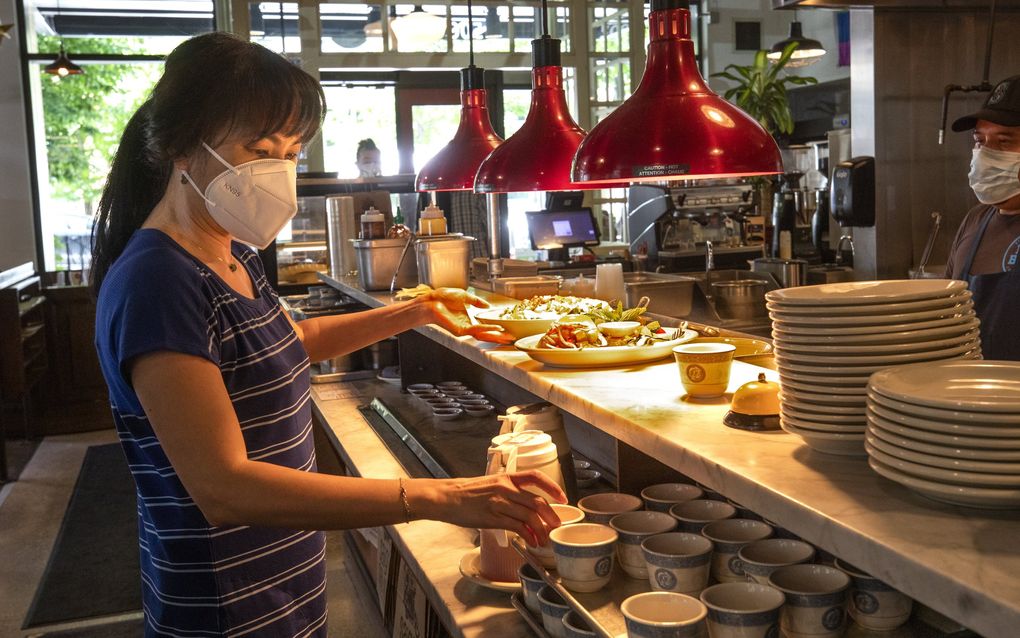
At Ba Bar in South Lake Union, co-owner Teresa Nguyen picks up an order to take to a table last week. Nguyen and her husband, Eric Banh, have to work the front of the house because they can’t find servers, hosts and chefs. They lost most of their employees when they had to shut down due to the pandemic and have not been able to replace them yet. (Ellen M. Banner / The Seattle Times)
When Ba Bar restaurant in South Lake Union was preparing to reopen in May, owners Eric Banh and Teresa Nguyen had so much trouble hiring staff they had to host and bus tables themselves. When a cook went home sick, the kitchen was so short-staffed they had to shut the whole restaurant for the night.
It’s a similar story across town at Bar del Corso in Beacon Hill. On a recent Saturday, owner Jerry Corso was so short-staffed he had to multitask as pizzaiolo, prep cook, host and server, dessert-plater and takeout order taker.
Labor is so tight Corso won’t be able to fully open by June 30, when the last pandemic restrictions on restaurants are lifted. If he loses a single cook in meantime, “it really is panic mode,” Corso said.





No comments:
Post a Comment